As the electric vehicle (EV) revolution accelerates, automotive manufacturers face immense pressure to not only innovate but also reinvent their production lines for greater agility, efficiency, and quality. The Indian electric vehicle (EV) market is projected to grow to USD 117.78 billion by 2032, exhibiting a CAGR of 22.4% during the forecast period.
At the core of this transformation lies the Body-in-White (BIW) platform—a sophisticated framework comprising the welded sheet metal structure and subassemblies of a vehicle, prior to the addition of components like doors and trim. Modular BIW platforms, married to advanced automation, are fundamentally reshaping the future of EV production.
At Arcturax, we recognize that modular, automation-driven BIW architectures are the linchpin for the future of EV manufacturing—offering both scalability and precision for next-generation vehicle lineups. Let’s explore the role of modular BIW platforms for EV lineups in detail.
Modular BIW: The Backbone of EV Manufacturing Flexibility
The EV wave is driving automakers to expand and evolve their product lineups rapidly. With frequent model updates, platform sharing across brands, and a wider variety of architectures and body styles, legacy, one-size-fits-all assembly methods no longer suffice. That’s why manufacturers are embracing modular BIW platforms.
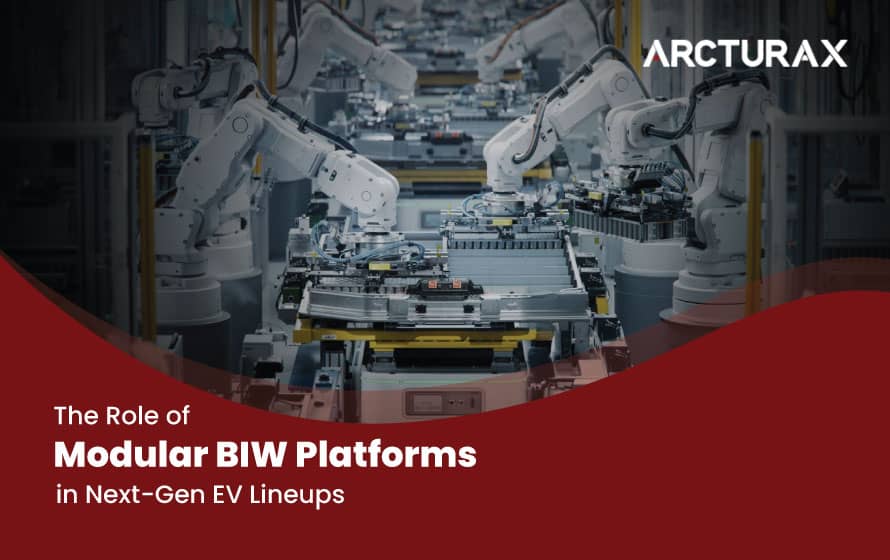
Modularity enables key body sections—such as floor, sidewall, and roof—to be designed as flexible modules. These modules can be adapted and recombined efficiently for different vehicle models, from compact EV city cars to rugged crossovers and commercial EVs. This approach minimizes the need for ground-up design and redevelopment with every new launch. Modular design also supports multi-model production on a single line, dramatically increasing the responsiveness of factories to changing market trends and customer demand.
Automation: Driving Efficiency, Precision, and Scalability
The true potential of modular BIW platforms for EVs is only realized when paired with cutting-edge automation technologies. Automation in BIW manufacturing extends far beyond simple robotic welding arms—it governs nearly every aspect of the modern body shop.
Flexible Assembly and Welding Lines
Incorporating automation into adaptable main assembly lines—covering floors, sidewalls, door covers, seat shells, and more—brings remarkable versatility to EV plants. Flexible welding workshops use robotics enhanced with vision systems, online inspection, and laser welding to ensure joints are executed with both speed and precision. Automated material handling, such as pallet or AGV-based transport, synchronizes modules seamlessly between different stations, further reducing human error and cycle times.
Advanced Joining Technologies
The growing reliance on lightweight materials in EVs—like high-strength steel, aluminum, magnesium, and composites—demands joining technologies that can consistently deliver strong bonds, regardless of material. Automated BIW platforms facilitate this through high-tech methods such as Flow Drill Screwing (FDS), Resistance Spot Welding (RSW), Self-Piercing Riveting (SPR), and advanced laser welding.
These sophisticated joining processes are integrated with robot-vision and online inspection to guarantee not just structural strength, but also traceability and repeatability for each vehicle produced. As a result, even as product variations increase, quality does not suffer[website].
End-to-End Engineering with Simulation and Virtual Commissioning
Automation isn’t confined to the assembly floor. BIW design and engineering now leverages simulation-based planning, CAD/CAx (Computer-Aided Design/Engineering), and virtual commissioning. Before a single physical part is produced, entire assembly lines and sequence logic are rigorously modeled, tested, and optimized in virtual environments. This approach slashes commissioning time, reduces physical trial-and-error, and ensures equipment downtime is minimized once the line goes live.
Real-Time Quality Control and Dimensional Accuracy
Manufacturing for EVs—where battery packaging, structural integrity, and crash performance are paramount—demands unswerving adherence to tight tolerances. Automation delivers on this through PLC-controlled assembly, in-line measurement systems, and robot vision for real-time quality checks. With data-driven feedback loops, the system continually self-corrects, ensuring each car body meets stringent standards before it moves deeper into final assembly.
Benefits Beyond the Factory
The synergy between modular BIW platforms and automation offers benefits that extend to every stakeholder:
- Manufacturers: Lower capital costs per model launch, reduced downtime, and higher throughput. Factories can reconfigure lines rapidly for model updates or new EV launches—an essential capability in today’s fast-paced industry.
- Engineers and Designers: Greater freedom to iterate on designs and introduce new features without completely overhauling the production setup.
- Consumers: Improved consistency and quality in finished vehicles, better safety, and innovative features delivered faster.
The future trajectory of BIW automation is, undeniably, data-driven. AI is primed to take automated BIW to the next level, enabling predictive maintenance, real-time anomaly detection, and self-optimizing lines. Digital twins of the factory environment and real-time analytics will empower decision-makers to continuously refine processes and implement innovations on the fly.
Empowering the Next Generation of EV Manufacturing
Modular BIW platforms, empowered by advanced automation, have redefined how the world’s most innovative electric vehicles are brought to life. They offer unparalleled flexibility, cost-effectiveness, and quality—crucial attributes for automakers striving to lead in the EV era.
As a leader in automotive manufacturing equipment solutions, Arcturax provides the BIW engineering equipment and expertise required to realize this vision. We offer Body-in-White Engineering equipment that are built to enable flexible, efficient, and fully automated EV production, integrating the latest in robotics, vision systems, and joining technologies for the highest process reliability and adaptability. Future-focused manufacturers seeking to transform their body shops for the EV era can rely on Arcturax’s BIW engineering solutions, ensuring every EV lineup is ready for tomorrow’s mobility—delivered with world-class efficiency, safety, and speed.
Contact us for a tailored consultation and discover how our Body-in-White Engineering equipment can future-proof your production line. Partner with us today and experience the next level of automation and efficiency in automotive manufacturing.