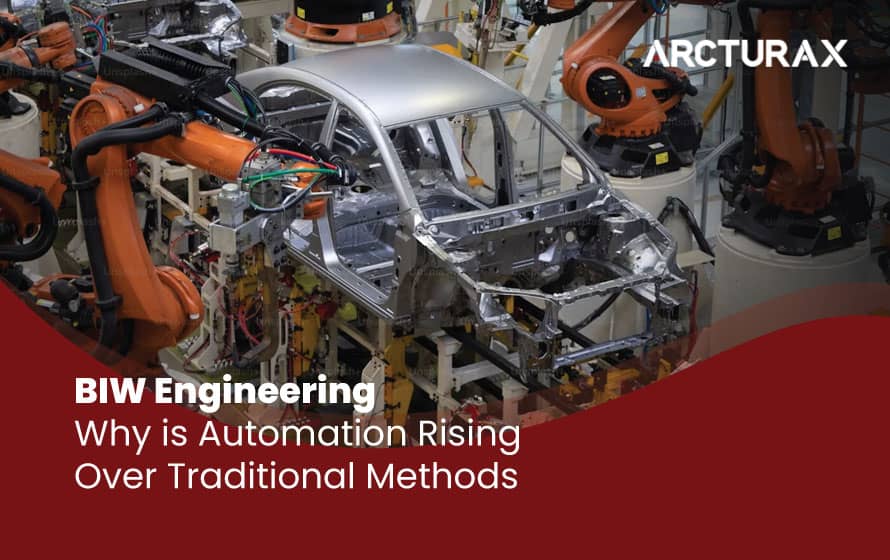
BIW defines the vehicle’s geometry and rigidity, serving as the base for everything that follows—paint, assembly, and quality checks. For decades, welding in BIW was performed by highly trained technicians operating conventional machinery. However, recent advances in automation and robotics are transforming the BIW landscape. India’s automotive robotics market is expected to reach US$35.90 million by 2029, with the BIW process-being crucial, at the forefront of this innovation.
At Arcturax, we are the leading provider of automotive manufacturing equipment and assembly lines, we understand that having a streamlined BIW process can make a significant difference in production efficiency and product quality. Let’s explore a detailed, point-by-point comparison between modern robotic welding solutions and traditional BIW welding approaches, helping automotive manufacturers understand the benefits and limitations of each method.
1. Precision and Consistency
Traditional welding methods in BIW heavily rely on human operators, whose skill levels can vary. While experienced welders are often capable of producing reliable joints, manual methods are inherently prone to fluctuations, minor errors, and inconsistencies, especially over long shifts. Fatigue, human error, and even subtle differences in personal technique can lead to variations in weld quality, potentially affecting the durability of the finished vehicle.
In contrast, automated assembly lines bring a new standard of accuracy and repeatability to BIW production. Robots operate with programmed precision, following exact trajectories, parameters, and timings every single cycle. Sensors, process control systems, and vision-integrated robots ensure welds maintain consistent strength and quality. Automated systems automatically adjust to compensate for minor deviations, yielding uniform welds even across thousands of units. In today’s demanding automotive sector, where precision is critical, robotic automation mercilessly outperforms traditional methods in maintaining quality and consistency. This results in reduced rework, lower scrap rates, and predictable vehicle performance across batches.
2. Speed and Throughput
Traditional BIW assembly lines, relying on human welders, are often limited by the physical and mental capabilities of the staff. Despite the best efforts and training, even the most proficient operators can only work so fast before speed compromises quality or safety. Breaks, shift changes, and inevitable downtime further impact productivity. Scaling up production relies on increasing headcount or extending shifts, both of which add costs and logistical complexity.
Automated BIW assembly lines, by contrast, operates with relentless efficiency. High-speed robotic arms can complete welds in a fraction of the time it would take a human, and they carry on without the need for rest or rotation. Advanced line balancing, multi-robot coordination, and parallel processing further boost throughput. Automation makes it feasible to meet just-in-time manufacturing deadlines and respond to fluctuating demand with minimal incremental cost. For high-volume BIW production, automation not only accelerates cycle times per unit but also maximizes overall plant capacity while keeping operational expenses predictable.
3. Safety and Ergonomics
Traditional welding exposes workers to significant workplace hazards: high temperatures, intense light, fumes, electrical risks, and repetitive motion injuries. Even with strict safety protocols and personal protective equipment, long-term exposure in welding shops can lead to chronic health concerns and workplace injuries. Manual, repetitive tasks also contribute to fatigue, which correlates with errors and accidents.
Robotic welding revolutionizes shop floor safety and ergonomics. Automated systems confine hazardous tasks to enclosed, shielded work cells, reducing operator exposure. Robots handle the most dangerous processes, allowing human workers to transition to supervisory, programming, and quality assurance roles in safer environments. Newer automation enables remote monitoring and digital control, safeguarding human well-being while achieving superior results. By removing workers from the proximity of welding arcs and heat, robotic automation not only prevents accidents but also improves workforce morale and reduces absenteeism linked to workplace strain.
4. Flexibility and Adaptability
Beyond brute repetition, BIW production increasingly demands flexibility—whether to handle customized vehicle designs, rapid model changeovers, or unique material combinations. Traditional welding setups are best suited for stable, long-term production runs. Any significant changes in a vehicle’s design or materials often require downtime, retooling, and retraining staff, initially causing delays and added expense.
Contemporary robotic welding solutions are designed for flexibility. They can be quickly reprogrammed to accommodate new vehicle architectures, different component geometries, or advanced joining methods like FDS (Flow Drill Screw), RSW (Resistance Spot Welding), and SPR (Self-Piercing Riveting). Robotic cells equipped with vision systems and automatic tool changers can switch seamlessly between programs, supporting dynamic manufacturing strategies and on-demand customization. This adaptability is especially valuable as automotive manufacturers contend with the shift toward lightweight materials, electric powertrains, and rapid design iteration cycles.
5. Quality Control and Inspection
Manual welding in traditional BIW lines relies on post-process visual inspection and periodic destructive tests to verify weld integrity. Human inspectors, while skilled, can overlook microscopic flaws, and comprehensive testing is rarely feasible for every joint due to production pressures. Inconsistent quality control may allow defective welds to escape detection, ultimately undermining vehicle safety and brand trust.
Automated BIW manufacturing unlocks new horizons for integrated, real-time quality assurance. Modern automation incorporates in-line inspection technologies such as laser scanning, machine vision, and thermal imaging, which monitor weld quality as each joint is created. Detailed data collection and analytics enable closed-loop feedback, automatically flagging or correcting deviations on the fly. By designing quality assurance directly into production, robotic BIW lines achieve both higher yield rates and rigorous documentation for compliance, ultimately fostering a more reliable and traceable product record.
6. Cost Efficiency and ROI
Conventional wisdom sometimes suggests that traditional welding is less costly, owing to lower upfront investment. However, this view often overlooks the total cost of ownership. Manual approaches incur ongoing expenses from labor, training, injuries, production downtime, and fluctuating scrap rates. As industry standards evolve and labor costs rise, the economics of manual solutions become less favorable.
Automation of BIW manufacturing requires significant initial investment, but the long-term benefits are quantifiable and compelling. Robots reduce direct labor costs, minimize waste, and deliver higher output for given square footage. Predictable maintenance schedules and declining costs of robotic technology mean that manufacturers reap savings over time, with ROI often realized within a few years of commissioning. In a market that prizes efficiency and profit margins, automation presents a financially responsible choice for forward-looking automotive manufacturers.
7. Advanced Joining Techniques and Technological Integration
Traditional welding is limited primarily to established methods, such as MIG or basic spot welding, which may suffice for conventional vehicle platforms but struggle with composites or new energy vehicles. As the industry embraces emerging material technologies—such as lightweight alloys, aluminum, and high-strength steels—the limitations of manual welding become more apparent.
Robotic BIW automation excels precisely in these advanced applications. Modern systems are engineered to handle new energy vehicles’ unique requirements, deploying techniques like laser welding, remote wire-feed, and hybrid joining. Integration of robot vision systems ensures precision placement and adaptation to diverse materials and thicknesses. Automated platforms readily incorporate new joining processes and can be future-proofed with modular upgrades, ensuring manufacturers stay ahead of evolving automotive tech trends.
8. Data, Connectivity, and Industry 4.0
Traditional BIW welding processes often lack digital traceability. Data collection, if performed at all, is manual and error-prone. This makes traceability, performance analytics, and continuous improvement harder to achieve, limiting management’s ability to respond swiftly to quality escapes or process deviations.
The latest automation brings BIW operations into the realm of Industry 4.0. Robotic systems are connected, data-driven, and highly transparent. They provide actionable insights through real-time monitoring, predictive maintenance, and seamless integration with factory management software. Data generated during production doesn’t just verify welds; it powers ongoing process optimization. Ultimately, digitised BIW welding supports agile, intelligent factories—capable of responding instantly to changing demands, supply chain disruptions, and evolving customer expectations.
Arcturax’s Advanced BIW Manufacturing Equipment
Arcturax’s BIW manufacturing equipment is engineered to meet the modern demands of automotive production with unmatched flexibility and technical sophistication. The comprehensive portfolio covers the design and manufacture of fully flexible main assembly lines capable of adapting to diverse vehicle models and production shifts with minimal downtime. Whether it’s the assembly of floors, side walls, door covers, or intricate sub-assemblies like seating and structural components, Arcturax combines robust engineering and intelligent automation throughout every production stage.
The inclusion of flexible welding workshops that seamlessly integrate robot vision systems allows for precise, high-speed material handling and joining. Online inspection technologies and laser welding solutions provide real-time quality assurance, while advanced joining techniques such as Flow Drill Screwing (FDS), Resistance Spot Welding (RSW), and Self-Piercing Riveting (SPR) ensure durable, reliable connections in both traditional vehicles and new energy platforms.
These key technologies, alongside quantitative material connection innovations, deliver a future-proof solution designed for industry evolution. Arcturax’s BIW equipment is underpinned by strong design and manufacturing capabilities, positioning it as the partner of choice for automotive manufacturers aiming to optimize efficiency, enhance quality, and lead in technological advancement.
The Path Forward with Arcturax’s BIW Automation
Comparing robotic welding automation with traditional manual approaches in BIW illuminates one clear trend: automation delivers unmatched advantages in precision, speed, safety, flexibility, quality, cost efficiency, innovation, connectivity, and sustainability. As automotive OEMs and suppliers confront growing pressures—from evolving product mixes and labor availability to rigorous quality and sustainability targets—the move toward automated BIW solutions is not just inevitable, but vital.
At Arcturax, we have leveraged years of industrial expertise to bring automated BIW equipment to automobile manufacturers that embodies the highest standards of flexibility, reliability, and innovation. With strong capabilities in both traditional assembly and the sophisticated requirements of new energy vehicle production, Arcturax’s solutions empower manufacturers to unlock transformative gains in performance and sustainability.