In the modern manufacturing environment, cutting down on waste is more than just a sustainability goal – it’s a competitive advantage. Refrigerator manufacturers are constantly looking for innovations that are effective, sustainable, and cost-efficient. Various studies indicate that 10-15% of raw materials, including insulation foam and other components, are wasted during traditional refrigerator production processes. This figure rises to as much as 20% in less-optimized production lines.
With increasing pressure to operate leaner, smarter, and more sustainably, adopting advanced automation tools and systems has become critical. One such innovation driving this transformation is the advanced Linear Cabinet Forming Line, which can significantly reduce waste production.
At Arcturax, we believe these solutions are not only technical marvels but also redefine how efficiency is achieved in processes like cabinet production for appliances. They combine precision engineering with automation to minimize errors, reduce material wastage, and optimize resource utilization. What’s more, they streamline manufacturing steps to eliminate inefficiencies in ways manual interventions cannot replicate. For refrigerator manufacturers seeking to align with green practices while simultaneously lowering costs, these systems have proven indispensable.
But how exactly are these advanced linear cabinet forming lines revolutionizing refrigerator manufacturing? Let’s dive in and uncover the innovative ways they create a more resource-efficient and sustainable production process.
1. Precise Injection Technology
Linear cabinet forming lines leverage highly accurate injection systems that introduce materials into molds with precision like no other. Whether it’s foam for insulation or other materials used in cabinet production, these machines operate with tight control over the quantity of material injected. This eliminates common issues like overfilling, which waste valuable resources, and ensures better quality results.
The integration of automated injection units ensures consistency in every cycle, reducing the risk of inconsistencies in mold production. The machines’ capacity to calibrate material flow ensures precise filling for various cabinet designs. Additionally, these systems adapt to different cabinet dimensions and adjust the material output accordingly, enabling manufacturers to produce only what is absolutely necessary, avoiding wastage.
Precision injection technology also minimizes spillage and overspray, reducing cleanup time and boosting operational productivity. This technology ensures a cleaner, safer production environment while driving down costs associated with material waste.
2. Optimized Material Usage Through Smart Digital Control
Resource costs are mounting, and traditional “safety margin” overfills now represent silent profit leaks. Modern forming lines leverage meticulously integrated electronic control systems. These systems use sensors, actuators, and feedback loops to ensure that every foaming shot and thermoforming cycle uses only what is needed—no more, no less. This level of accuracy can significantly reduce the margin of error in material consumption.
Manufacturers frequently struggle with overuse of consumables due to batch-to-batch variability, but automation brings a new level of trust to your production efficiency and profit forecasts. These control systems dynamically monitor material utilization in real-time, optimizing processes during operations. Precision material dispensing capabilities also lead to uniform outcomes, improving production consistency by a significant margin.
Moreover, automated systems eliminate downtimes caused by manual recalibration, ensuring a steady production flow while minimizing material wastage from defective outputs. This precision helps future-proof your process in the face of rising material costs, directly converting optimization into bottom-line advantage.
3. Streamlined Layouts Reduce Handling Waste
A key contributor to waste in traditional processes is excessive manual handling and poorly designed production layouts. Linear cabinet forming lines tackle this challenge by employing streamlined, automated power roller systems and straight-line production layouts. These optimized layouts eliminate unnecessary processes like re-stacking, manual repositioning, or delays caused by inefficient workflows, which often lead to material damage or waste.
By automating transitions between key stages of cabinet production, these lines eliminate unwanted handling steps and related inefficiencies. Automated layouts reduce reliance on bulky intermediate materials, such as protective wraps or handling substrates, saving resources spent on secondary processes. These organizational upgrades significantly contribute to reducing handling waste not only in individual tasks but across the entire production chain.
Additionally, streamlined layouts create a safer and more ergonomic working environment for employees, further minimizing accidents that could spoil materials or halt production lines. This systematic reduction in handling waste results in a more sustainable and smooth operation.
4. Advanced Heating Systems
Traditional production lines often utilize energy-intensive heating methods that consume excessive resources and create significant material and energy wastage. Linear cabinet forming lines, however, are outfitted with cutting-edge circulating water heating systems governed by precise temperature controllers. These systems regulate the amount of energy used in the molding process, making the method significantly more efficient.
This energy-efficient heating not only minimizes material waste caused by temperature deviations but also reduces the chance of overheating or damaging products within molds. Additionally, these heating systems use advanced sensors to adjust thermal parameters for different cabinet specifications, further ensuring optimal material use without excess or under utilization.
This energy-efficient innovation minimizes environmental contamination and energy-related waste as less power is consumed. Over time, the system’s reduced energy footprint indirectly lowers production costs while aligning with sustainability goals. Manufacturers enjoy dual advantages—better environmental compliance and energy savings in their operations.
5. Foaming Control with Integrated Nitrogen Management
Few error sources lead to more persistent, messy waste than uncontrolled foaming—especially overflow, under-cure, and spillage that not only waste chemicals but require extensive cleanup and downtime. Sophisticated forming lines address this through two-directional delivery units equipped with automatic nitrogen filling devices. This system maintains a stable, inert, and finely tunable foaming environment.
Precise control of expansion processes minimizes waste generated during foam application. Proper foaming control directly ensures uniform insulation density with each cycle, delivering better quality outcomes. Stability in foam application reduces the risk of material overspray and spillages, eliminating the need for frequent cleanups and associated downtime.
By maintaining a highly controlled and efficient foaming environment, manufacturers mitigate the costs of both waste disposal and compliance challenges, ultimately contributing to more eco-friendly production workflows.
6. Automation Prevents Overproduction
In many conventional manufacturing lines, overproduction occurs when human errors or manual equipment adjustments create an imbalance between demand and output. Automated processes in linear forming lines, however, enable just-in-time manufacturing. These systems are capable of customizing production schedules by size and demand, ensuring that only the required units are produced at any given time.
By integrating closely with demand forecasts and production planning systems, automated lines prevent excess production and inventory buildup. This results not only in waste reduction but also in significant savings on storage and transportation costs related to surplus inventory.
Why Automation Is at the Core of Waste Reduction?
At a time when manufacturers are expected to meet tight deadlines while maintaining sustainable practices, automation emerges as the hero. Here’s why automation, as embraced by linear cabinet forming lines, plays such a critical role:
- Fewer Human Errors: Machines programmed for precision perform tasks without variances, eliminating errors that lead to reworks or wasted material.
- Predictable Outputs: Automation ensures consistent cycle times, helping manufacturers accurately gauge resources needed for specific outputs and minimize excess material requirements.
- Resource Efficiency: Automated systems focus on precision, meaning every gram of material is utilized as effectively as possible.
- Greater Monitoring Capacity: With advanced electronic controls, automation enables real-time data monitoring to track material usage, identify inefficiencies, and immediately correct issues.
Automation is no longer a luxury; it’s the cornerstone of sustainable, waste-free production.
Arcturax’s Linear Cabinet Forming Line
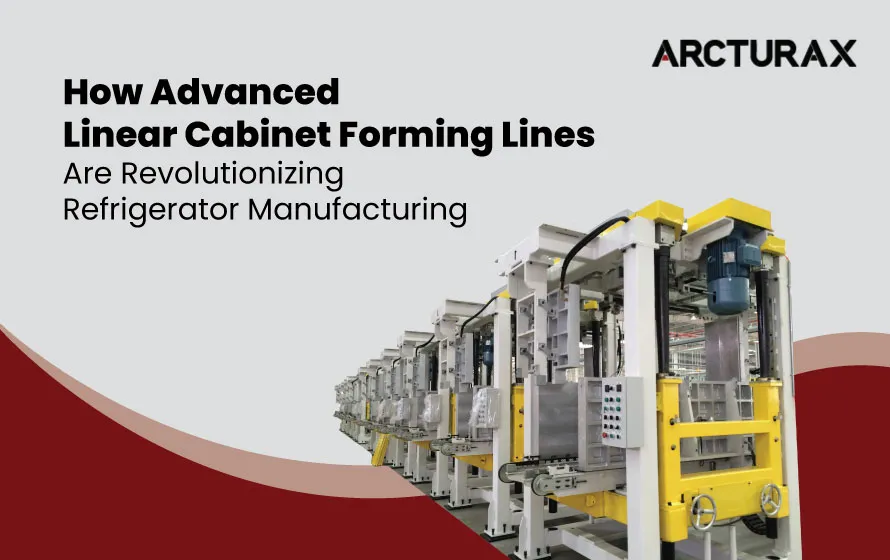
Arcturax’s Linear Cabinet Forming Line is a highly advanced system designed for precision, efficiency, and sustainability in cabinet production. The line incorporates cutting-edge features such as a preheating oven, power roller line, two-direction delivery unit with automatic nitrogen filling, and foaming fixtures, ensuring seamless operation across the production process. Additionally, the integration of a circulating water heating system with precise temperature control enhances consistency and energy efficiency.
With automatic injection units, pneumatic systems, and intelligent electronic controls, the line can adapt to varying cabinet dimensions, making it versatile for diverse production needs. Its linear layout reduces environmental impact and labor intensity while boosting productivity through streamlined, automated processes. Featuring compact construction and compatibility with multiple cabinet types, Arcturax’s system is ideal for manufacturers prioritizing precision, cost-effectiveness, and sustainability.
This robust and feature-rich forming line is a game-changer for modern industrial manufacturing.
Minimize Waste, Revolutionize Your Refrigerator Manufacturing
Linear cabinet forming lines have transformed how manufacturers approach waste reduction. From precision injection systems to streamlined layouts and environmentally friendly heating technology, these machines ensure that every resource is used as efficiently as possible. By incorporating advanced automation and optimizing each stage of the production process, manufacturers can confidently reduce waste by 20% or more.
If you’re seeking a reliable partner to revolutionize your refrigerator manufacturing process, Arcturax’s Linear Cabinet Forming Lines represent the perfect solution. Designed with sustainability, precision, and efficiency in mind, our forming lines empower businesses to reduce costs, meet green initiatives, and maintain superior product quality. Let’s connect for the ideal linear cabinet forming line for your manufacturing needs — share your requirements with us today!