As the world addresses the urgent climate imperatives, every sector is being called upon to curb emissions and innovate for sustainability. The refrigeration industry, historically reliant on high-global-warming-potential (GWP) refrigerants and energy-intensive processes, now stands at the center of a global transformation. A key force driving this paradigm shift away from conventional, emission-heavy systems to modern, low-emission solutions is the rise of automation in refrigerator manufacturing.
At Arcturax, we have witnessed first-hand how advances in factory automation underpin the global transition to sustainable refrigeration. This evolution not only helps manufacturers comply with tightening efficiency regulations but also enhances competitiveness by optimizing output, reducing waste, and improving product quality. Let’s explore why automation is pivotal to the low-emission revolution in refrigeration, unpack how leading manufacturers are driving change, and examine the opportunities and challenges on the horizon.
The Call for Low-Emission Refrigeration
The demand for low-emission refrigerators is being shaped by a confluence of regulatory, environmental, and consumer trends:
- Stricter Environmental Regulations: Governments worldwide have introduced stricter standards on refrigerant GWP, energy efficiency, and lifecycle emissions, such as Europe’s F-Gas Regulation, the U.S. EPA’s SNAP program, and India’s HCFC Phase-out Management Plan.
- Commercial Responsibility: Manufacturers now recognize sustainable practices as a competitive advantage, driven by consumer demand for green products and corporate commitments to carbon neutrality.
- Innovation in Cooling Technologies: The shift from hydrofluorocarbons (HFCs) to low-GWP alternatives like R600a (isobutane) and hydro-fluoroolefins (HFOs) is critical, but new materials and precise engineering are required for safe, reliable applications.
- Lean Manufacturing and Circularity: Factories aim to conserve resources throughout the product life-cycle, from design to end-of-life recycling.
These imperatives have made traditional, manually-intensive manufacturing lines increasingly impractical. Automation emerges as the key enabler for addressing all dimensions of the sustainability challenge.
How Automation Enables Low-Emission Manufacturing
1. Precision in Material Handling and Processing
Producing low-emission refrigerators demands extreme accuracy—from the forming of cabinet liners and doors to the foaming of insulating components using eco-friendly agents. Automated lines utilize programmable logic controllers (PLCs), machine vision, and multi-axis robotics to ensure tight tolerances and consistency, minimizing material waste and energy consumption:
- Vacuum Thermoforming Lines automate the shaping of cabinet and door liners, ensuring uniform wall thickness for optimal insulation and structural integrity while reducing excess material[website].
- Automated Foaming Machines precisely dispense water-blown or HFO-based agents, replacing high-GWP refrigerants while ensuring optimal density and adhesion.
- Sheet Metal Forming Lines with integrated robotics enhance the production speed and consistency of commercial freezer shells, further trimming waste and defects.
As a result, these production systems drive both resource conservation and the reliable manufacture of high-efficiency products.
2. Integrated, Energy-Efficient Operations
Modern automated factories employ advanced integration at all stages of the refrigeration assembly line, enabling seamless material flow and minimizing process bottlenecks. Such integration offers multifaceted energy and emission savings:
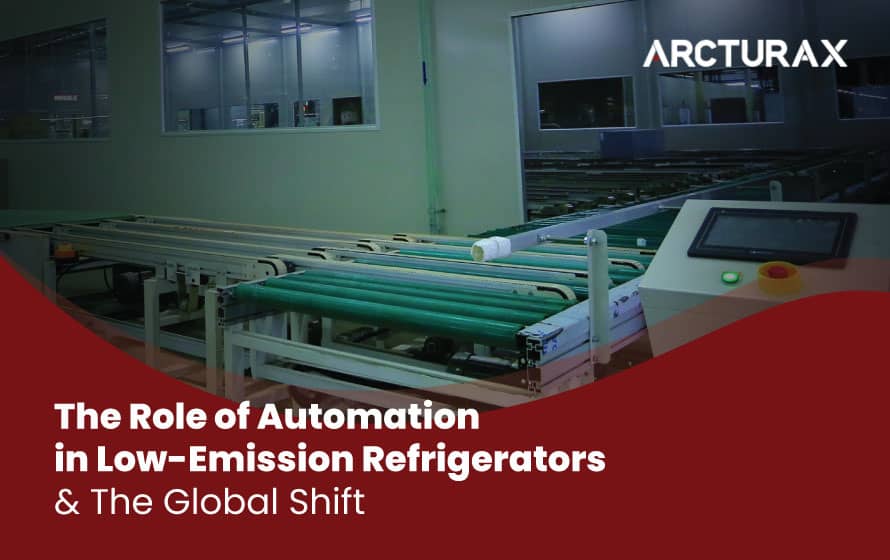
- Conveyor-Driven Assembly Lines optimize throughput and reduce manual handling, which minimizes idle times and standby energy loss.
- Sensor-Based Control Systems dynamically adjust power consumption and operating variables in real time for tasks such as panel forming, foam injection, and curing.
- Smart Monitoring utilizing IIoT (Industrial Internet of Things) dashboards enables predictive maintenance, ensuring each machine operates at peak efficiency—a boon for sustainability as well as profitability.
In aggregate, these technologies make automated refrigerator facilities far more energy efficient compared to traditional, labour-heavy plants.
3. Intelligent Quality Control for Defect Reduction
Every defect drains resources, raises scrap rates, and increases the carbon footprint. Automated inspection and testing lines now employ:
- Machine Vision Systems for real-time defect detection in molded panels, door shells, and insulating components.
- In-Line Leak and Refrigerator Performance Testing Lines ensure that refrigerant systems are perfectly sealed and energy ratings meet or exceed regulatory baselines.
- Automated Rejection and Rework Systems isolate flaws before they enter downstream processes, saving energy and material.
The net result is a dramatic reduction in both rework and landfill waste, critical for the industry’s carbon neutrality goals.
4. Enabling Advanced, Sustainable Materials
Automated production platforms are uniquely capable of adapting to the handling of advanced, sustainable materials—be it thin-walled plastics, bio-based foams, or high-strength, low-alloy steels. Automation allows precise control over panel forming, cabinet forming, cutting, and joining processes that might be too complex or inconsistent for manual labor. This directly supports the adoption of next-generation eco-friendly technologies in mass production.
Additionally, automation systems can rapidly recalibrate and optimize production parameters for new material types, streamlining the transition from traditional components to sustainable alternatives. Robotic dispensing and welding technologies ensure even distribution and secure bonding of innovative materials, maintaining product integrity at scale.
5. Data-Driven Decision-Making at Scale
A defining advantage of smart automation is the ability to continuously capture and analyze production data. By aggregating information from thousands of sensors, manufacturers can:
- Track energy usage and CO2 emissions in real time.
- Benchmark process performance and identify inefficiencies for targeted improvements.
- Validate compliance with green certifications and reporting requirements.
In the era of ESG (Environmental, Social, and Governance) metrics, this level of transparency has become an indispensable differentiator.
The Indian Refrigerator Market Opportunity
India, as one of the world’s fastest-growing refrigerator markets, provides a prime case study. Ambitious “Make in India” targets, burgeoning middle-class demand, and mounting pressure to meet global sustainability standards all combine to create enormous potential.
Indian manufacturers, both established and emerging, are actively modernizing their facilities. Automation is vital in enabling:
- Compliance with Bureau of Indian Standards (BIS), PLI, and global certifications.
- Integration with IIoT for centralized monitoring, efficiency, and predictive analytics.
- Drastic improvements in defect rates, energy intensity, and output scalability.
As the competitive landscape evolves—with both global and local players investing in transformative projects—the companies that automate now will spearhead the next generation of low-emission refrigeration.
Adopt Automation for Low-Emission Refrigerator Manufacturing
The global shift to low-emission refrigerators is not simply a regulatory response—it is an innovation race, where the winners will be those who effectively combine environmental stewardship with operational excellence. Automation is the technology that makes this shift not only possible but also profitable.
At Arcturax, we remain at the forefront of this transformation, helping leading manufacturers across India and around the world with smart, automated refrigerator production lines designed for the low-emission age. With our extensive portfolio—including automated thermoforming, foaming, assembly, and testing solutions—we empower your business to meet the challenges of tomorrow while achieving superior efficiency and sustainability today.
Ready to lead the shift toward smarter, greener manufacturing?
Contact Arcturax for a tailored consultation and discover how our advanced automation solutions can boost your production efficiency, reduce emissions, and future-proof your refrigerator manufacturing operations.
Let’s build a sustainable and profitable future—together.